Pontiac · Traditional Pontiac V8
Pontiac 389 V8
The engine that powered Pontiac's early-1960s performance rise and helped ignite the muscle-car era in the GTO.
389
Cubic inches
The 389 became the engine most closely associated with Pontiac's early performance transformation. Installing it in the 1964 Tempest-based GTO created one of the defining muscle-car formulas.
Displacement
389 ci
Bore
4.0625"
Stroke
3.75"
Years
1959–1966
Key Takeaway
The 389 paired Pontiac's 4.0625-inch bore with a longer 3.75-inch stroke while retaining the same broad external architecture. Two-barrel, four-barrel, and Tri-Power induction allowed the engine to serve everything from full-size cars to the GTO.
Technical Specifications
- Horsepower
- Varies by year/application; see documented variants
- Torque
- 428 lb-ft @ 3200 rpm in 1964 GTO 325 hp four-barrel specification; 428 lb-ft @ 3600 rpm with Tri-Power
- Architecture
- 90-degree OHV V8
- Block
- Cast iron
- Cylinder heads
- Cast iron
- Valvetrain
- Pushrod OHV, 2 valves per cylinder
- Aspiration
- Naturally aspirated
- Fuel delivery
- Two-barrel, four-barrel and Tri-Power carburetion depending application
- Main bearings
- 5; 3.00-inch main-journal family
The 389 paired Pontiac's 4.0625-inch bore with a longer 3.75-inch stroke while retaining the same broad external architecture. Two-barrel, four-barrel, and Tri-Power induction allowed the engine to serve everything from full-size cars to the GTO.
Internal Specifications
Variant-specific values are labeled. Engine families that span multiple years or RPOs can have different heads, cams, induction and rotating parts, so the exact code/year always takes priority.
Notable Applications
Strengths
- Iconic Tri-Power and GTO heritage
- Compact external dimensions shared across much of Pontiac's V8 family
- Strong aftermarket and restoration support
Weaknesses / Watch-outs
- Pre-1965 accessory and cylinder-head details require careful interchange research
- Original Tri-Power systems can be expensive
Common Upgrades
- Modernized Tri-Power or four-barrel intake
- Aluminum cylinder heads
- Hydraulic roller camshaft
Racing History & Legacy
The 389 was central to Pontiac's early-1960s street-performance image and appeared alongside larger Super Duty engines during the division's factory competition years.
The 389 is one of Pontiac's most culturally important engines because of its connection to the original GTO.
References & Image Credit
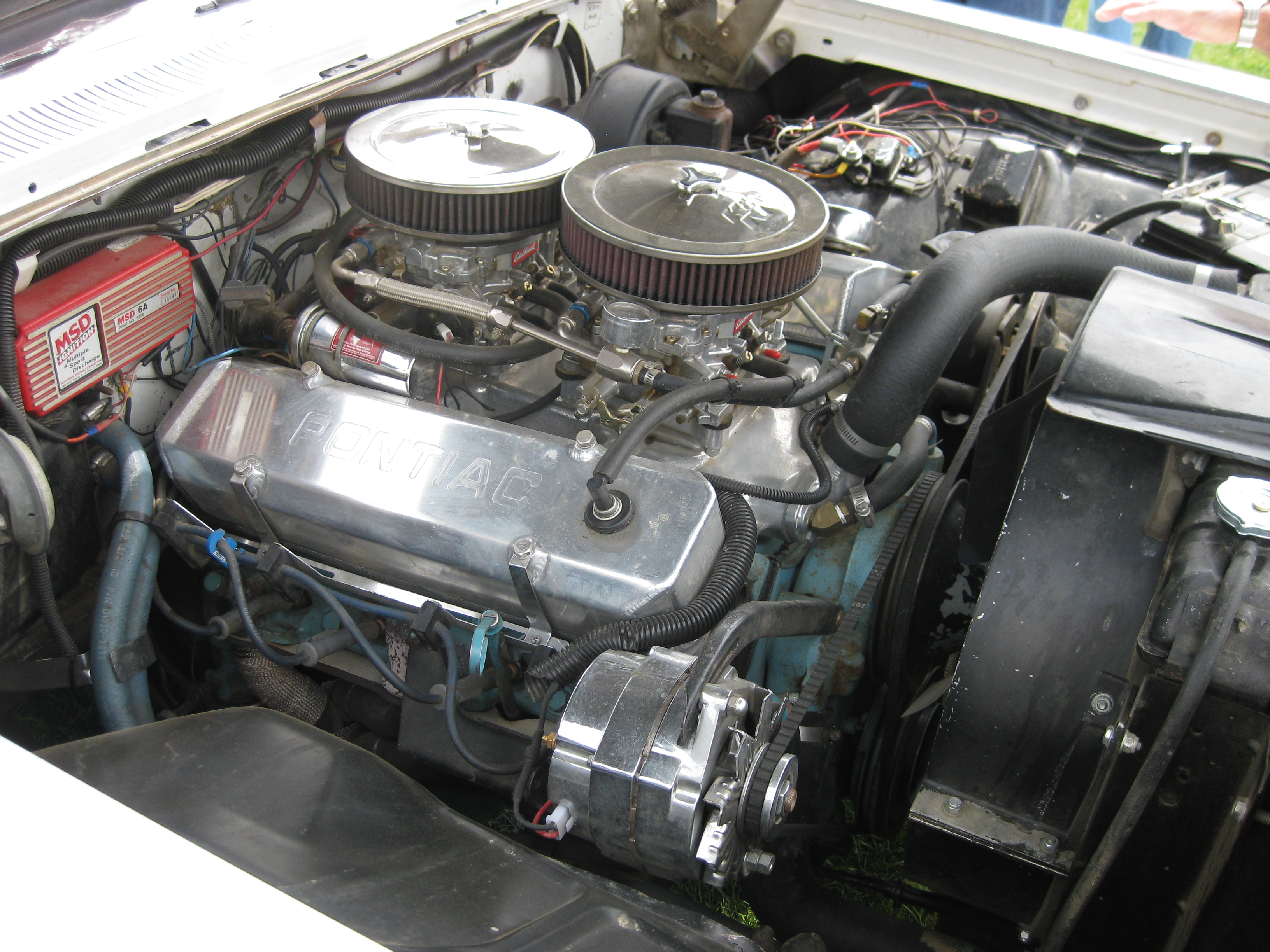
Engine image: dave_7 · CC BY 2.0 · source
Hemmings — Pontiac engine history
historical reference
Hemmings — GM A-body and GTO origins
historical reference
Hemmings — 1963 Catalina 389/421 specifications
technical reference
SD Performance — Pontiac engine bore, stroke and journal specifications
specialist engine specification
1964 Pontiac mid-size fact sheet — GTO 389 torque specifications
historical spec
Engineering Notes Worth Knowing
389 cu in / 6.4 L with 4.0625 x 3.75-inch bore and stroke.
Traditional Pontiac 90-degree OHV V8.
Available with two-barrel, four-barrel, and Tri-Power carburetion.
Used in Catalina, Bonneville, Grand Prix, and 1964–66 GTO applications.
History · context · related reading
The Story Behind Pontiac 389 V8
The 389 became the engine that transformed Pontiac's image. Installing it in the lighter Tempest-based GTO created the formula that would define the muscle-car era.
TorqueList Garage Reference Series
See this engine inside the full Pontiac reference catalog.
The same Engine Library data now powers a more detailed mobile-friendly catalog with technical specs, variants, engineering notes, history and related stories.